While the world monitors EU’s AI Passports (read our geopolitical report) and Tesla’s robots (see Optimus Gen 3), a quiet revolution is happening in the lab. Today, April 10, 2026, leading pharmaceutical giants announced that “Agentic AI” has officially moved from experimental to essential, fundamentally changing how we fight disease.
1. From Screening to Synthesis: The 40% Speed Boost
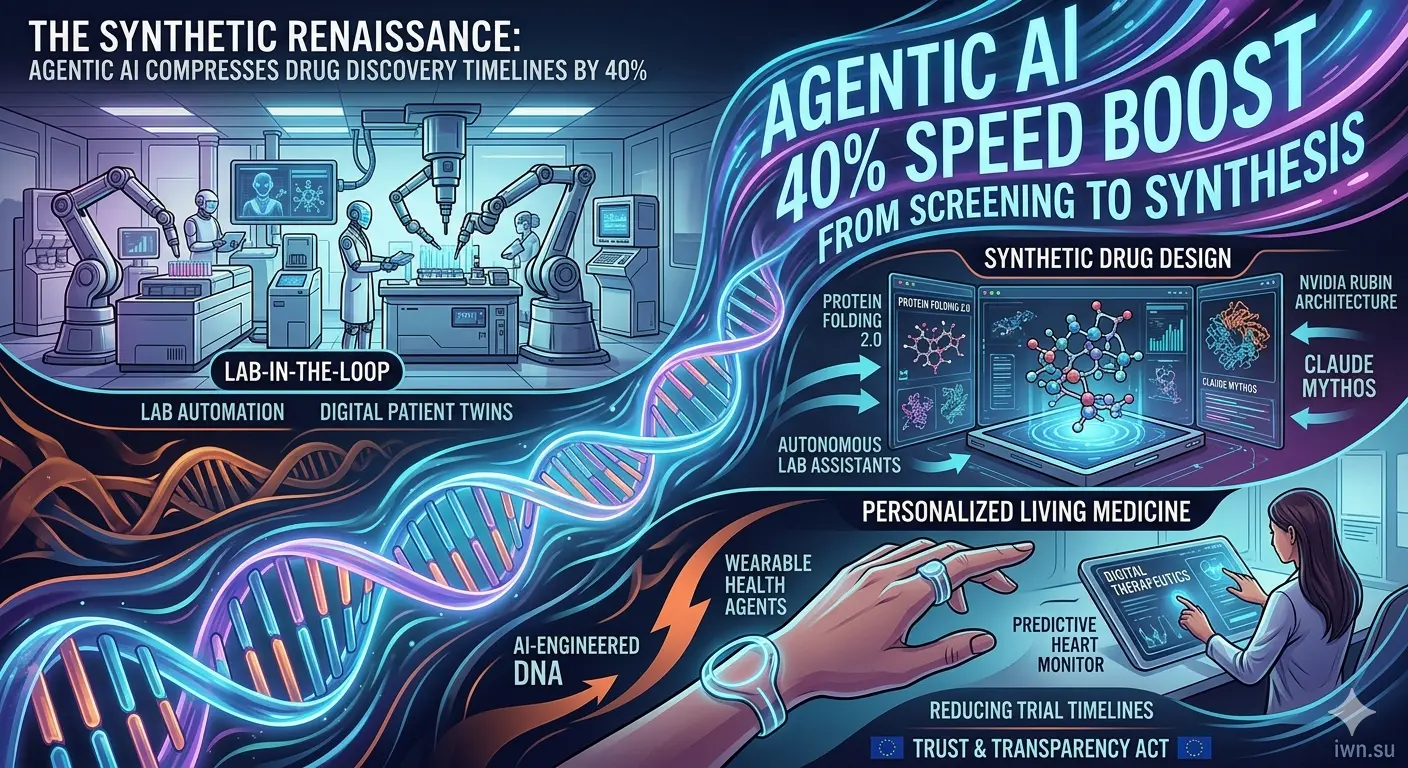
In 2024, developing a new drug cost $2.6 billion and took over a decade. In 2026, the industry has entered the “Synthetic Renaissance.” By using agentic workflows — where AI models like Claude Mythos (check its reasoning power) act as autonomous lab assistants — researchers are compressing early discovery timelines by up to 40%.
How it works:
- Lab-in-the-loop: AI doesn’t just predict molecules; it autonomously designs experiments for robotic arms to execute.
- Digital Twins: Instead of traditional placebo arms, clinical trials are now using “Digital Patient Twins” to simulate drug reactions, reducing the need for human testing in Phase 1.
- Protein Folding 2.0: Building on the legacy of AlphaFold, new models running on NVIDIA Rubin architecture can now predict the dynamic movement of proteins in real-time.
2. Personalized “Living” Medicine
We are moving away from “one size fits all” pills. 2026 is the year of Digital Therapeutics.
- AI-Engineered DNA: Generative models are now used to design regulatory DNA sequences with unmatched precision, ushering in highly targeted gene therapies.
- Wearable Health Agents: Integrated with new AI wearables, these systems monitor your biometrics 24/7 and can predict a cardiac event or glucose spike hours before it happens.
3. The Ethical Frontier: Trust and Transparency
As AI becomes the primary engine of value in pharma, the “Black Box” problem is more critical than ever. Under the new EU regulations we discussed earlier, all medical AI must now be audit-ready and fully transparent.
“The biggest advances in 2026 won’t come from flashy demos, but from practical tools embedded in clinical care,” says Dr. Hugo Aerts of Mass General Brigham.
Verdict: AI for Humanity
By the end of 2026, the success of AI will be measured not by benchmarks or stock prices, but by lives saved. The convergence of Open-Source models and massive industrial compute is finally solving the most complex puzzle of all: the human body.
Stay informed with IWN.SU — your source for the future of health and technology.
"Questi calendari potrebbero interessarvi:
- Good Morning pictures with a cup

- Good morning pictures with cats

- Good Morning pictures with heart

- Good Morning pictures with Minions

- Physical AI 2026: Tesla Optimus Gen 3 Enters…
- Good Morning pictures with flowers

- Claude Mythos Released: Anthropic’s 10-Trillion…
- Good Morning pictures with puppies

- AI Cinema & Gaming 2026: From Static Worlds to…
- The Death of the Desktop: How "Action-OS" is…

- Good morning: new images 2024

- Anthropic Unveils ‘Project Glasswing’: Claude Mythos…