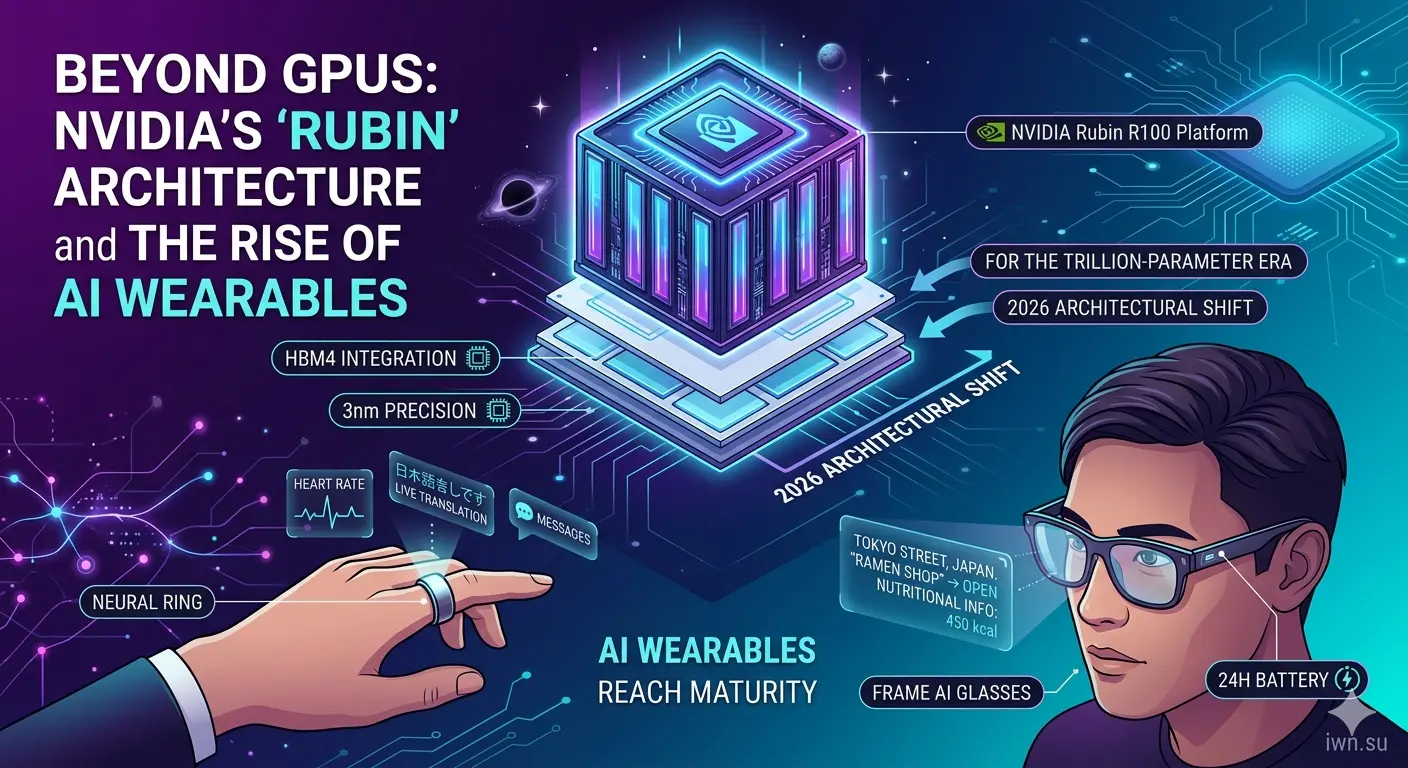
While the software world obsesses over LLMs, the hardware foundation is undergoing its most significant shift in a decade. Today, NVIDIA has officially shared more details about its upcoming Rubin architecture, and a new wave of AI-native wearables is ready to replace the smartphone.
1. NVIDIA Rubin: The Successor to Blackwell is Here
Just as the industry started to adapt to the Blackwell B200, NVIDIA’s CEO has teased the Rubin R100 platform. Named after Vera Rubin, the astronomer who confirmed the existence of dark matter, this new architecture is built for the “trillion-parameter era.”
What makes Rubin special?
- HBM4 Integration: The R100 will be the first to utilize High Bandwidth Memory 4, drastically reducing energy consumption while doubling throughput.
- 3nm Precision: Built on TSMC’s refined 3nm process, Rubin is expected to be 4x more efficient than its predecessors.
- The “AI Foundry” Model: NVIDIA is no longer just selling chips; they are providing “AI Blueprints” for entire industries to build custom models.
As reported by NVIDIA’s official blog, the transition from Blackwell to Rubin will be the fastest architectural shift in the company’s history.
2. The Death of the Screen? AI Wearables Reach Maturity
The “Humane Pin” and “Rabbit R1” failures of 2024 are now distant memories. In 2026, a new generation of devices—like the Frame AI Glasses and the Neural Ring—are proving that we might not need screens at all.
- Multimodal Reality: These devices use “Vision-Language Models” to see what you see. Imagine walking through a market in Tokyo and having your glasses live-translate signs and whisper the nutritional value of street food into your ear.
- Battery Breakthroughs: Thanks to the TurboQuant algorithm we discussed earlier, these wearables can now last 24 hours on a single charge by processing most tasks locally.
3. Why Hardware is the New Software
In 2026, the competitive advantage has moved from “who has the best model” to “who has the most efficient hardware.” Companies that can’t run their AI locally on consumer devices are losing users to those who can.
Editor’s Note: For more on how to run these powerful models yourself, check out our guide on the Top 10 Open-Source LLMs for 2026.
Verdict: A Hardware-First Future
The combination of NVIDIA’s industrial power and the miniaturization of AI chips means that by the end of 2026, “AI” won’t be a destination you visit (like a website); it will be the invisible layer through which you see the world.
Stay tuned to IWN.SU for the latest hardware teardowns and AI breakthroughs.
"Questi calendari potrebbero interessarvi:
- Anthropic Unveils ‘Project Glasswing’: Claude Mythos…
- Saturn–Neptune Conjunction 2026: Detailed Horoscope…

- The Death of the Desktop: How "Action-OS" is…

- The Synthetic Renaissance: Agentic AI Compresses…

- Beyond Copilots: How Autonomous AI Agents are…

- Physical AI 2026: Tesla Optimus Gen 3 Enters…
- EU Mandates "AI Passports" and Restricts Chip…

- Claude Mythos Released: Anthropic’s 10-Trillion…

- AI Cinema & Gaming 2026: From Static Worlds to…
- OpenAI’s $122B Surge and Apple’s Siri Overhaul: The…

- Top 10 Open-Source LLMs to Run Locally in 2026:…

- Good night images for friends
