As we move toward a world of Action-Oriented Operating Systems and autonomous agents, a critical question remains: how will we power it all? Today, April 10, 2026, the discussion has shifted from model parameters to Megawatts.
1. The 100-Gigawatt Challenge
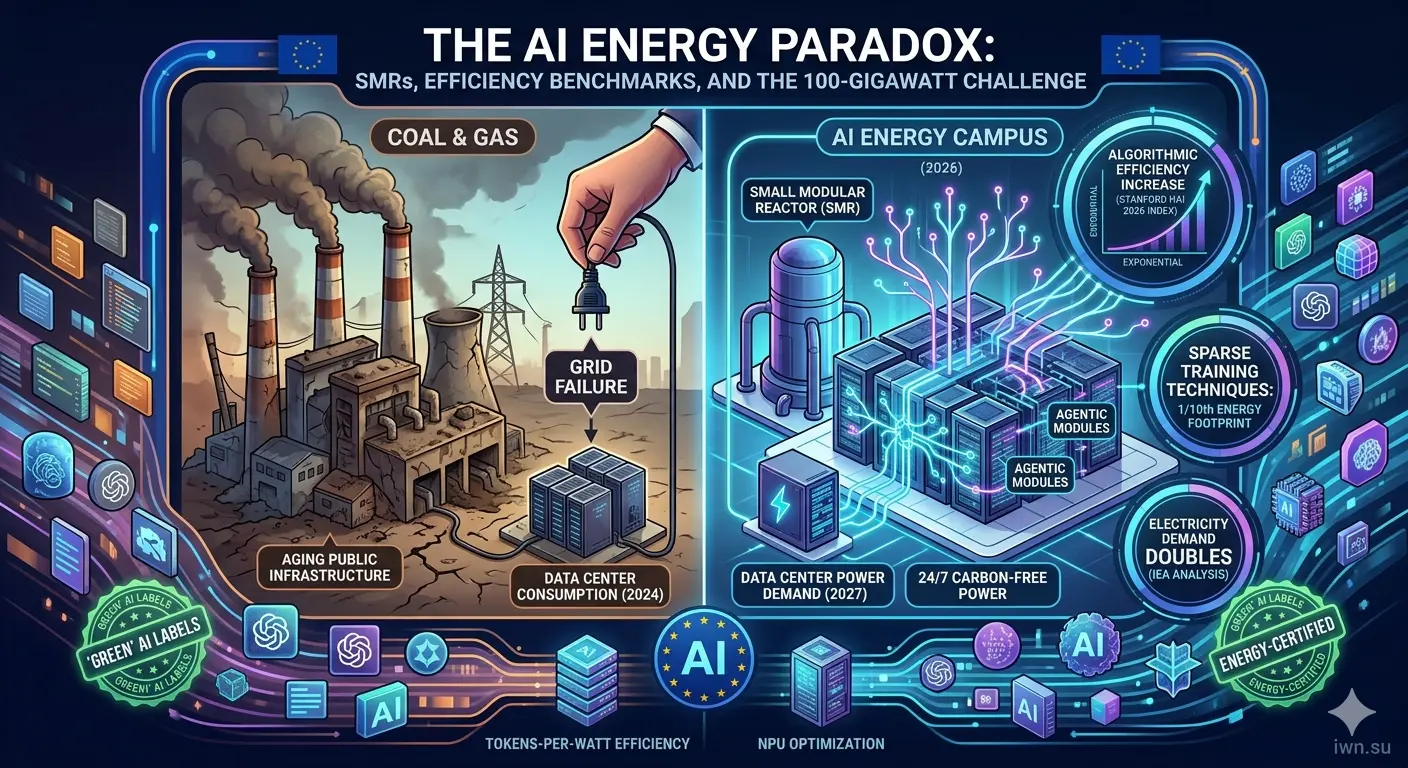
The rapid expansion of AI data centers has pushed global energy grids to their limits. According to a recent International Energy Agency (IEA) analysis, the electricity consumption of data centers is expected to double by 2027, reaching a level equivalent to the entire power demand of Japan.
To combat this, tech giants are no longer just software companies; they have become energy pioneers. Small Modular Reactors (SMRs) are now being deployed directly on-site at “AI campuses” to provide 24/7 carbon-free power, bypassing the aging public infrastructure.
2. Efficiency is the New “IQ”
The industry is moving away from “brute-force” scaling. Researchers at the Stanford Institute for Human-Centered AI (HAI) have released a 2026 index showing that algorithmic efficiency is now improving faster than hardware performance. New “sparse” training techniques allow models to achieve higher reasoning capabilities with only 1/10th of the traditional energy footprint.
This shift is crucial for mobile devices and wearables, where battery life is the ultimate bottleneck. By optimizing how NPUs (Neural Processing Units) handle background tasks, developers are managing to keep devices cool even while running complex agentic workflows.
3. The Rise of “Green” AI Labels
Following the lead of the new EU regulations, the market is seeing the first “Energy-Certified” AI models. Consumers and enterprises are beginning to choose models not just based on their ELO score, but on their Tokens-per-Watt efficiency.
“Sustainability is no longer a corporate social responsibility goal; it’s a hard requirement for the survival of the AI industry,” says a lead analyst at Bloomberg NEF.
Verdict: The Sustainable Intelligence Era
The “Synthetic Renaissance” depends on our ability to generate clean, abundant energy. In 2026, the winners won’t just be those with the best algorithms, but those with the most efficient power stacks.
Stay tuned to IWN.SU for deep dives into the infrastructure of the future.
"Questi calendari potrebbero interessarvi:
- Beyond Copilots: How Autonomous AI Agents are…

- Anthropic Unveils ‘Project Glasswing’: Claude Mythos…
- Claude Mythos Released: Anthropic’s 10-Trillion…
- Saturn–Neptune Conjunction 2026: Detailed Horoscope…

- EU Mandates "AI Passports" and Restricts Chip…

- Top 10 Open-Source LLMs to Run Locally in 2026:…
- The Death of the Desktop: How "Action-OS" is…

- Taurus Horoscope 2026 — A Year of Steady Growth,…

- Aries Horoscope for 2026

- Beyond GPUs: NVIDIA’s "Rubin" Architecture and the…
- AI Cinema & Gaming 2026: From Static Worlds to…

- Physical AI 2026: Tesla Optimus Gen 3 Enters…