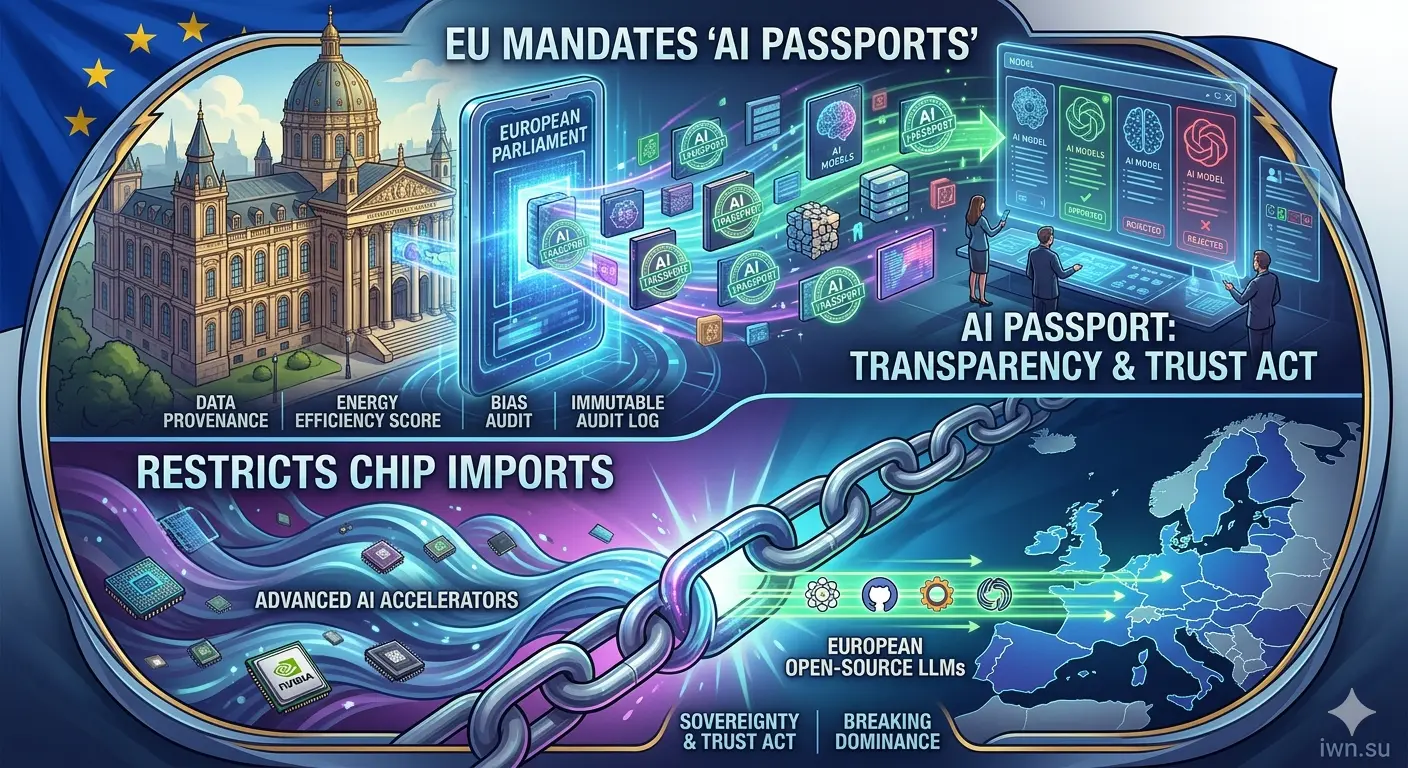
In a landmark decision today, April 10, 2026, the European Parliament has finalized the “Sovereignty & Trust Act,” a sweeping regulation that redefines how artificial intelligence is deployed across the continent. While Tesla’s Optimus Gen 3 enters production (read our robotics analysis here), the EU is building a regulatory fortress.
1. The “AI Passport”: Transparency at Every Level
Starting January 1, 2027, every AI model operating within the EU—from Claude Mythos (see our cybersecurity breakdown) to local Gemma 4 forks—must possess a digital “AI Passport.”
What is an AI Passport?
- Data Provenance: A verified log of all data used for training, ensuring no copyrighted material was used without a license.
- Energy Efficiency Score: A mandatory rating on the model’s carbon footprint, directly impacting computational taxes.
- Bias & Safety Audit: An immutable record of third-party audits proving the model meets EU ethical standards.
According to the official European Commission portal, models without a valid passport will face immediate blocks at the ISP level and fines of up to 7% of global turnover.
2. The Chip Blockade: Open-Source or No Entry
The most controversial part of the Act targets hardware. The EU will restrict the import of AI accelerators—including upcoming NVIDIA Rubin chips—unless they provide native, un-throttled support for a predefined list of European Open-Source LLMs.
Why this matters:
- Breaking Dominance: The EU wants to prevent a hardware-software “walled garden” (like Apple’s old Siri ecosystem) where only proprietary models thrive.
- Boosting Local Talent: This guarantees a market for European AI labs focusing on open, interoperable models.
3. Industry Reaction: A Divided Future
While the Open-Source Initiative (OSI) hails the Act as a victory, major tech conglomerates warn of a “fragmented internet.” The Digital Europe trade group stated, “This risks isolating Europe from the most advanced AI breakthroughs in exchange for regulatory purity.”
Verdict: The Geopolitics of Intelligence
In 2026, AI is no longer just a tool; it is a weapon of economic and political influence. By mandating “AI Passports,” the EU is asserting its role not as an innovator, but as the world’s primary regulator.
For businesses operating in Europe, the compliance race has just begun.
Stay ahead of the regulatory curve with IWN.SU. We cover the intersection of AI, law, and business.
"Questi calendari potrebbero interessarvi:
- Physical AI 2026: Tesla Optimus Gen 3 Enters…
- The Synthetic Renaissance: Agentic AI Compresses…
- AI Cinema & Gaming 2026: From Static Worlds to…

- Claude Mythos Released: Anthropic’s 10-Trillion…
- Anthropic Unveils ‘Project Glasswing’: Claude Mythos…
- The Death of the Desktop: How "Action-OS" is…

- Happy Birthday Gemma

- Saturn–Neptune Conjunction 2026: Detailed Horoscope…

- Top 10 Open-Source LLMs to Run Locally in 2026:…
- Horoscope 2026: A Bright Year Ahead for Every Zodiac Sign

- The Energy Paradox: Can AI Scale Without Melting the Grid?
- Aries Horoscope for 2026
