While Tesla’s robots learn to walk and scientists accelerate drug discovery, the entertainment world is undergoing a “Creative Big Bang.” As of April 10, 2026, generative AI has officially moved from a “fun toy” to the backbone of Hollywood and the Global Gaming industry.
1. The Death of the Script? Dynamic NPCs and Living Lore
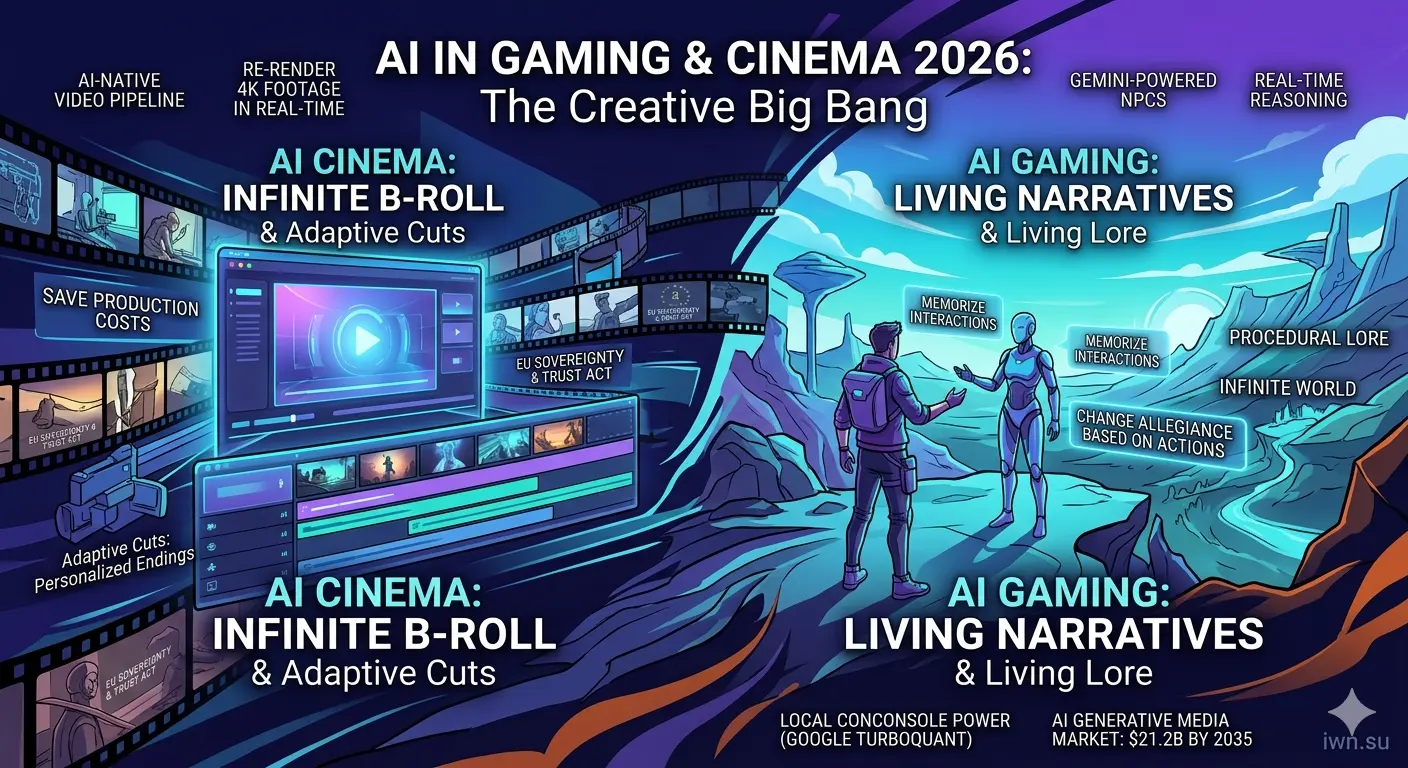
At the recent GDC 2026, Google and NVIDIA showcased a breakthrough: Gemini-powered NPCs (Non-Player Characters) that no longer rely on pre-written dialogue trees.
What’s new:
- Real-time Reasoning: Using models like Claude Mythos (see its performance stats), characters can now remember every interaction with the player and change their allegiance based on your actions.
- Procedural Lore: Entire game worlds are being generated on-the-fly, ensuring that no two players ever have the same adventure.
- On-Device Performance: Thanks to Google’s TurboQuant, these complex AI interactions can now run locally on gaming consoles without lag.
2. AI-Native Cinema: “Infinite B-Roll” and Real-Time Editing
In London this week, Adobe and NVIDIA unveiled the first AI-native video pipeline.
- The End of Reshoots: If a scene needs a different lighting or weather, AI tools can now re-render the 4K footage in real-time using generative layers, saving millions in production costs.
- Personalized Movies: Streaming giants are experimenting with “Adaptive Cuts”—movies where the ending or certain subplots change based on the viewer’s preferences.
- Copyright & “AI Passports”: To comply with the new EU Sovereignty & Trust Act, every AI-generated frame in high-budget films must now be watermarked and registered.
3. The Human Factor: Resistance and Collaboration
It’s not all smooth sailing. 52% of game developers still express skepticism about generative AI, fearing a loss of “human soul” in creativity. However, the market speaks for itself: the Generative AI media market is projected to reach $21.2 billion by 2035, with 2026 being the pivotal year of mass adoption.
Editor’s Note: Running these cinematic models requires massive power. Check out our deep dive on NVIDIA’s Rubin architecture to see the hardware behind the magic.
Verdict: The Era of “Expressing Intent”
In 2026, the barrier between an idea and a finished masterpiece is thinner than ever. We are moving from “writing code” and “editing frames” to “expressing intent.” The creator of the future is a conductor of an AI orchestra.
Stay tuned to IWN.SU — we cover the tech that entertains your soul.
"Questi calendari potrebbero interessarvi:
- Claude Mythos Released: Anthropic’s 10-Trillion…
- The Synthetic Renaissance: Agentic AI Compresses…
- Physical AI 2026: Tesla Optimus Gen 3 Enters…
- Anthropic Unveils ‘Project Glasswing’: Claude Mythos…
- Beyond GPUs: NVIDIA’s "Rubin" Architecture and the…
- The Death of the Desktop: How "Action-OS" is…

- Top 10 Open-Source LLMs to Run Locally in 2026:…
- EU Mandates "AI Passports" and Restricts Chip…

- The Energy Paradox: Can AI Scale Without Melting the Grid?
- OpenAI’s $122B Surge and Apple’s Siri Overhaul: The…
- Taurus Horoscope 2026 — A Year of Steady Growth,…

- Aries Horoscope for 2026
